What Is Goal-Oriented Customer Experience (And Why Should You Care)?
Marketing Team
Jan 23, 2026
AI should never get a free pass just because it’s “innovative.” If it’s not reliably collecting payments, resolving issues, or booking high-value conversations, it’s just another cost. Not a productive investment.
That’s the core idea behind goal-oriented customer experience: stop measuring AI by how impressive it sounds and start measuring it by whether it actually does the job you hired it for.
In this post, we’ll unpack the goal-oriented framework we shared during our recent São Paulo, Bogotá, and Mexico City workshops and explain how goal-oriented AI agents fit into real-world collections, service, and sales operations.
Quick definition: What is “goal-oriented” CX AI?
Goal-oriented customer experience means designing your AI workforce around specific, measurable business outcomes (like “collect a payment” or “book a meeting”), not vague ideas like “answer any customer questions, even if they’re not related to the topic” It’s about AI that performs real work, within clear guardrails, managed just like any other team member.
Why isn’t “just automate” enough for contact centers?
Most CX or IT leaders we meet have already tried some form of automation:
A chatbot on the website
A basic IVR that routes calls (on a good day)
A “virtual assistant” that answers FAQs
On paper, these projects often look fine: deflection rates go up, a slice of volume moves out of human queues, and the slideware is full of arrows pointing in the right direction.
But when you ask harder questions—Are we collecting more money? Are we resolving more issues on the first contact? Are we closing more deals?—the room often goes quiet.
The problem usually isn’t the technology itself. AI is a necessary component of the future of customer service. Human-only models can’t keep up with increasing need and involve costs and turnover that are oppressing corporate bottom lines.
No, the problem with AI is how AI projects are framed:
Success is “launching a bot,” not hitting a revenue or CX target
Scope is “handle as much as possible,” not “do a specific job very well”
Governance is an afterthought, not a design constraint
In other words, many implementations optimize for activity, not outcomes.
A goal-oriented customer experience flips that thinking. It starts with the jobs that matter—collections, service, sales—and designs AI agents for customer service, collections, or sales to deliver on those jobs with the same clarity you expect from your human teams.
How is goal-oriented CX different from generic bots?
Old model: generic bots and rough containment
In the typical setup:
A bot tries to handle “all questions” in a channel
Conversation scripts are a mix of FAQs and flows
Measurement is mostly about containment: What % of sessions stayed with the bot?
You can push some simple volume into self-service this way. But the more you ask the bot to do, the more fragile and unpredictable it becomes, especially in voice-heavy environments like banking, telco, or collections.
A simple standard to apply internally is: if the AI can’t stand up to the same KPI review as your human teams, it’s not ready.
A goal-oriented model: AI workers with real jobs
In a goal-oriented model, you don’t start from the channel or the bot. You start from the job:
“Recover early-stage delinquent accounts respectfully and in compliance”
“Resolve card or billing issues in one interaction”
“Qualify and book meetings for high-intent inbound leads”
Each AI worker is designed around that job:
It has a clearly defined goal and success metric
It knows the policies, constraints, and escalation paths that apply
It’s evaluated on goal completion, not on “conversations managed”
Instead of a single generic assistant, you end up with a small, focused team of AI workforce for contact centers, each responsible for a slice of your customer journey, just like your human org chart.
This is where the language of AI agents for collections, AI agents for customer service, and AI for outbound sales stops being a collection of buzzwords and starts sounding like roles on a real team.
How does our G.O.A.L. framework work in practice?
“Goal-oriented CX” only becomes useful when you can operationalize it. That’s what our G.O.A.L. (Goal Oriented Agent Logic) framework is for: a way to design and run goal-oriented AI agents that behave like accountable team members, not black boxes.
G.O.A.L. is a goal-first conversation framework that turns AI from open-ended chat into a reliable digital worker. It keeps interactions natural for customers, but structured enough for operations teams to trust, measure, and improve.
G.O.A.L. means every AI conversation starts with a clear objective, follows a guided path to completion, and stays inside guardrails. So the agent doesn’t just “help.” It completes a business outcome.
What problem does G.O.A.L. solve?
Most conversational AI is optimized to talk well. That’s not the same as finishing work.
Without a framework like G.O.A.L. , AI often:
Drifts into long conversations without closure
Misses required steps or key data
Escalates too early or too late
Creates inconsistent experiences across customers
Becomes hard to govern because results are unpredictable
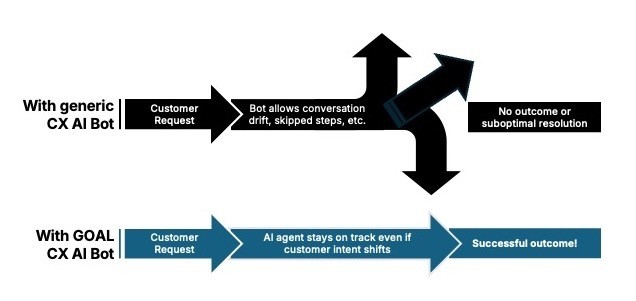
G.O.A.L. fixes that by designing conversations like real workflows: clear “start,” clear “done,” and a safe route in between.
Here’s a visualization of this key difference between typical CX AI and G.O.A.L. CX AI.
How G.O.A.L. works
Think of GOAL like GPS for customer conversations:
It sets the destination (the outcome)
It guides the conversation step-by-step
It adapts if the customer changes direction
It confirms arrival with a clear definition of success
Customers experience it as a smooth conversation. Your business experiences it as consistent execution.
Why G.O.A.L. is better than a typical AI agent or chatbot
It’s outcome-driven, not chat-driven
It blends natural speech with business logic
It’s measurable by design
What are the business benefits?
G.O.A.L. typically delivers:
Higher completion rates because conversations are designed to end in “done”.
Fewer escalations and less rework because required steps and confirmations are built in.
More consistent compliance because guardrails are embedded in the flow, not left to chance.
Faster optimization because you can see where outcomes break and fix specific steps.
Better customer experience because the conversation stays clear, confident, and efficient.
Why are voice-first AI agents so important for goal-oriented CX?
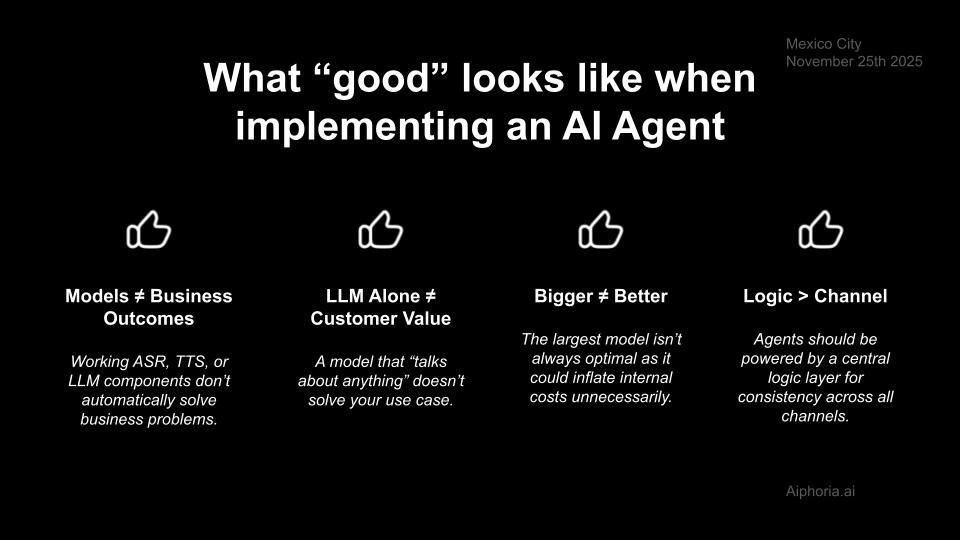
In many markets (including LatAm), a huge share of revenue and risk still flows through the phone. That’s why we emphasize voice-first AI agents, not chatbots with a telephone plugin.
Voice-first matters for goal-oriented CX in three big ways:
Natural conversations → higher completion
If customers can speak naturally—interrupt, change their mind mid-sentence, mix languages—they’re more likely to stay with the AI through to completion.
That directly affects your ability to hit the goal (payment completed, issue resolved, meeting booked).
Speed and responsiveness → trust and patience
Streaming recognition and responsive speech mean customers don’t feel they’re “talking to a machine that needs to think.”
That reduces abandonment and makes it easier to sustain complex flows like multi-step verification.
Consistency across channels → simpler operations
Once you’ve designed a goal-oriented AI worker for voice, you can expose the same logic over WhatsApp, web chat, or in-app messaging.
The outcome is the same; only the channel changes.
For leaders, this means they can design once, deploy many times, and measure outcomes consistently using a single enterprise-ready AI platform rather than a patchwork of tools.
What realistic results can you expect from G.O.A.L. -driven CX?
During our workshops, we were able to share real-world results from across different customers and regions, such as:
Collections
Up to 10x better payment efficiency in early-stage delinquency
7–10% improvements in recovery rates on comparable segments
Service
80%+ automation on carefully selected workflows
0 seconds waiting time for those journeys
Sales
2x improvement in key sales outcomes (meetings booked, qualified conversations)
Up to 50% lower cost per lead/contact in outbound pilots
Check out this real-world case study for actual results.
How do you get started with goal-oriented customer experience?
You don’t need a multi-year transformation to get started. Here’s a practical path you can follow for near-term implementation.
1. Choose one or two high-value jobs
Resist the temptation to “transform everything.” Pick 1–2 jobs where:
Volume is high
Rules and guardrails are clear
Success is easy to define (payment, resolution, booking, activation)
Typical candidates:
Early-stage collections reminders
Appointment rescheduling
Simple billing or transaction queries
Lead qualification for a specific campaign
2. Define success and guardrails up front
Before you see a single prototype, write down:
Goal & metrics
What counts as success?
What metrics will you track (completion rates, cost per outcome, CX measures)?
Guardrails
What is the AI worker allowed to do or offer?
When must it escalate?
What phrases or behaviors are off limits?
This is where you align CX, Operations, IT, and Risk, and make trustworthy, compliant AI for customer interactions a shared responsibility.
3. Design an AI worker, not “just a bot”
Whichever provider you work with, be sure to ask for:
A clear description of the worker’s job
A view of the flows and rules that implement the GOAL framework
Access to transcripts and analytics that show performance
A plan to iterate based on real interactions over the first 90 days
If you can see and manage the AI worker like a new hire—goals, training plan, scorecard—you’re on the right track.
Final takeaway: AI that actually does the job
Goal-oriented customer experience is not about chasing the latest model or hitting an abstract “automation rate.”
It’s about building an AI workforce for contact centers that:
Has clear jobs
Operates within clear guardrails
Can be measured on business outcomes
Makes life better for customers and for your human teams
That’s why it resonated so strongly in the LatAm workshops: it gives leaders a proven framework they can take back to their boards, regulators, and frontline teams.
If you’d like to explore what a goal-oriented AI worker could look like in your own collections, service, or sales environment, the easiest next step is a working session with your CX, operations, IT, and risk stakeholders in the room. Map the jobs, define the goals, and see where AI belongs—and where human expertise should stay firmly in charge.
Hearing is believing, though. So set up a the demo of voice-first AI CX that can be a cornerstone tool in that effort.
Other resources to explore?
Anton Shestakov
What Is Goal-Oriented Customer Experience (And Why Should You Care)?
Marketing Team
Jan 23, 2026
AI should never get a free pass just because it’s “innovative.” If it’s not reliably collecting payments, resolving issues, or booking high-value conversations, it’s just another cost. Not a productive investment.
That’s the core idea behind goal-oriented customer experience: stop measuring AI by how impressive it sounds and start measuring it by whether it actually does the job you hired it for.
In this post, we’ll unpack the goal-oriented framework we shared during our recent São Paulo, Bogotá, and Mexico City workshops and explain how goal-oriented AI agents fit into real-world collections, service, and sales operations.
Quick definition: What is “goal-oriented” CX AI?
Goal-oriented customer experience means designing your AI workforce around specific, measurable business outcomes (like “collect a payment” or “book a meeting”), not vague ideas like “answer any customer questions, even if they’re not related to the topic” It’s about AI that performs real work, within clear guardrails, managed just like any other team member.
Why isn’t “just automate” enough for contact centers?
Most CX or IT leaders we meet have already tried some form of automation:
A chatbot on the website
A basic IVR that routes calls (on a good day)
A “virtual assistant” that answers FAQs
On paper, these projects often look fine: deflection rates go up, a slice of volume moves out of human queues, and the slideware is full of arrows pointing in the right direction.
But when you ask harder questions—Are we collecting more money? Are we resolving more issues on the first contact? Are we closing more deals?—the room often goes quiet.
The problem usually isn’t the technology itself. AI is a necessary component of the future of customer service. Human-only models can’t keep up with increasing need and involve costs and turnover that are oppressing corporate bottom lines.
No, the problem with AI is how AI projects are framed:
Success is “launching a bot,” not hitting a revenue or CX target
Scope is “handle as much as possible,” not “do a specific job very well”
Governance is an afterthought, not a design constraint
In other words, many implementations optimize for activity, not outcomes.
A goal-oriented customer experience flips that thinking. It starts with the jobs that matter—collections, service, sales—and designs AI agents for customer service, collections, or sales to deliver on those jobs with the same clarity you expect from your human teams.
How is goal-oriented CX different from generic bots?
Old model: generic bots and rough containment
In the typical setup:
A bot tries to handle “all questions” in a channel
Conversation scripts are a mix of FAQs and flows
Measurement is mostly about containment: What % of sessions stayed with the bot?
You can push some simple volume into self-service this way. But the more you ask the bot to do, the more fragile and unpredictable it becomes, especially in voice-heavy environments like banking, telco, or collections.
A simple standard to apply internally is: if the AI can’t stand up to the same KPI review as your human teams, it’s not ready.
A goal-oriented model: AI workers with real jobs
In a goal-oriented model, you don’t start from the channel or the bot. You start from the job:
“Recover early-stage delinquent accounts respectfully and in compliance”
“Resolve card or billing issues in one interaction”
“Qualify and book meetings for high-intent inbound leads”
Each AI worker is designed around that job:
It has a clearly defined goal and success metric
It knows the policies, constraints, and escalation paths that apply
It’s evaluated on goal completion, not on “conversations managed”
Instead of a single generic assistant, you end up with a small, focused team of AI workforce for contact centers, each responsible for a slice of your customer journey, just like your human org chart.
This is where the language of AI agents for collections, AI agents for customer service, and AI for outbound sales stops being a collection of buzzwords and starts sounding like roles on a real team.
How does our G.O.A.L. framework work in practice?
“Goal-oriented CX” only becomes useful when you can operationalize it. That’s what our G.O.A.L. (Goal Oriented Agent Logic) framework is for: a way to design and run goal-oriented AI agents that behave like accountable team members, not black boxes.
G.O.A.L. is a goal-first conversation framework that turns AI from open-ended chat into a reliable digital worker. It keeps interactions natural for customers, but structured enough for operations teams to trust, measure, and improve.
G.O.A.L. means every AI conversation starts with a clear objective, follows a guided path to completion, and stays inside guardrails. So the agent doesn’t just “help.” It completes a business outcome.
What problem does G.O.A.L. solve?
Most conversational AI is optimized to talk well. That’s not the same as finishing work.
Without a framework like G.O.A.L. , AI often:
Drifts into long conversations without closure
Misses required steps or key data
Escalates too early or too late
Creates inconsistent experiences across customers
Becomes hard to govern because results are unpredictable
G.O.A.L. fixes that by designing conversations like real workflows: clear “start,” clear “done,” and a safe route in between.
Here’s a visualization of this key difference between typical CX AI and G.O.A.L. CX AI.
How G.O.A.L. works
Think of GOAL like GPS for customer conversations:
It sets the destination (the outcome)
It guides the conversation step-by-step
It adapts if the customer changes direction
It confirms arrival with a clear definition of success
Customers experience it as a smooth conversation. Your business experiences it as consistent execution.
Why G.O.A.L. is better than a typical AI agent or chatbot
It’s outcome-driven, not chat-driven
It blends natural speech with business logic
It’s measurable by design
What are the business benefits?
G.O.A.L. typically delivers:
Higher completion rates because conversations are designed to end in “done”.
Fewer escalations and less rework because required steps and confirmations are built in.
More consistent compliance because guardrails are embedded in the flow, not left to chance.
Faster optimization because you can see where outcomes break and fix specific steps.
Better customer experience because the conversation stays clear, confident, and efficient.
Why are voice-first AI agents so important for goal-oriented CX?
In many markets (including LatAm), a huge share of revenue and risk still flows through the phone. That’s why we emphasize voice-first AI agents, not chatbots with a telephone plugin.
Voice-first matters for goal-oriented CX in three big ways:
Natural conversations → higher completion
If customers can speak naturally—interrupt, change their mind mid-sentence, mix languages—they’re more likely to stay with the AI through to completion.
That directly affects your ability to hit the goal (payment completed, issue resolved, meeting booked).
Speed and responsiveness → trust and patience
Streaming recognition and responsive speech mean customers don’t feel they’re “talking to a machine that needs to think.”
That reduces abandonment and makes it easier to sustain complex flows like multi-step verification.
Consistency across channels → simpler operations
Once you’ve designed a goal-oriented AI worker for voice, you can expose the same logic over WhatsApp, web chat, or in-app messaging.
The outcome is the same; only the channel changes.
For leaders, this means they can design once, deploy many times, and measure outcomes consistently using a single enterprise-ready AI platform rather than a patchwork of tools.
What realistic results can you expect from G.O.A.L. -driven CX?
During our workshops, we were able to share real-world results from across different customers and regions, such as:
Collections
Up to 10x better payment efficiency in early-stage delinquency
7–10% improvements in recovery rates on comparable segments
Service
80%+ automation on carefully selected workflows
0 seconds waiting time for those journeys
Sales
2x improvement in key sales outcomes (meetings booked, qualified conversations)
Up to 50% lower cost per lead/contact in outbound pilots
Check out this real-world case study for actual results.
How do you get started with goal-oriented customer experience?
You don’t need a multi-year transformation to get started. Here’s a practical path you can follow for near-term implementation.
1. Choose one or two high-value jobs
Resist the temptation to “transform everything.” Pick 1–2 jobs where:
Volume is high
Rules and guardrails are clear
Success is easy to define (payment, resolution, booking, activation)
Typical candidates:
Early-stage collections reminders
Appointment rescheduling
Simple billing or transaction queries
Lead qualification for a specific campaign
2. Define success and guardrails up front
Before you see a single prototype, write down:
Goal & metrics
What counts as success?
What metrics will you track (completion rates, cost per outcome, CX measures)?
Guardrails
What is the AI worker allowed to do or offer?
When must it escalate?
What phrases or behaviors are off limits?
This is where you align CX, Operations, IT, and Risk, and make trustworthy, compliant AI for customer interactions a shared responsibility.
3. Design an AI worker, not “just a bot”
Whichever provider you work with, be sure to ask for:
A clear description of the worker’s job
A view of the flows and rules that implement the GOAL framework
Access to transcripts and analytics that show performance
A plan to iterate based on real interactions over the first 90 days
If you can see and manage the AI worker like a new hire—goals, training plan, scorecard—you’re on the right track.
Final takeaway: AI that actually does the job
Goal-oriented customer experience is not about chasing the latest model or hitting an abstract “automation rate.”
It’s about building an AI workforce for contact centers that:
Has clear jobs
Operates within clear guardrails
Can be measured on business outcomes
Makes life better for customers and for your human teams
That’s why it resonated so strongly in the LatAm workshops: it gives leaders a proven framework they can take back to their boards, regulators, and frontline teams.
If you’d like to explore what a goal-oriented AI worker could look like in your own collections, service, or sales environment, the easiest next step is a working session with your CX, operations, IT, and risk stakeholders in the room. Map the jobs, define the goals, and see where AI belongs—and where human expertise should stay firmly in charge.
Hearing is believing, though. So set up a the demo of voice-first AI CX that can be a cornerstone tool in that effort.
Other resources to explore?
Anton Shestakov
What Is Goal-Oriented Customer Experience (And Why Should You Care)?
What Is Goal-Oriented Customer Experience (And Why Should You Care)?
Marketing Team
Jan 23, 2026
AI should never get a free pass just because it’s “innovative.” If it’s not reliably collecting payments, resolving issues, or booking high-value conversations, it’s just another cost. Not a productive investment.
That’s the core idea behind goal-oriented customer experience: stop measuring AI by how impressive it sounds and start measuring it by whether it actually does the job you hired it for.
In this post, we’ll unpack the goal-oriented framework we shared during our recent São Paulo, Bogotá, and Mexico City workshops and explain how goal-oriented AI agents fit into real-world collections, service, and sales operations.
Quick definition: What is “goal-oriented” CX AI?
Goal-oriented customer experience means designing your AI workforce around specific, measurable business outcomes (like “collect a payment” or “book a meeting”), not vague ideas like “answer any customer questions, even if they’re not related to the topic” It’s about AI that performs real work, within clear guardrails, managed just like any other team member.
Why isn’t “just automate” enough for contact centers?
Most CX or IT leaders we meet have already tried some form of automation:
A chatbot on the website
A basic IVR that routes calls (on a good day)
A “virtual assistant” that answers FAQs
On paper, these projects often look fine: deflection rates go up, a slice of volume moves out of human queues, and the slideware is full of arrows pointing in the right direction.
But when you ask harder questions—Are we collecting more money? Are we resolving more issues on the first contact? Are we closing more deals?—the room often goes quiet.
The problem usually isn’t the technology itself. AI is a necessary component of the future of customer service. Human-only models can’t keep up with increasing need and involve costs and turnover that are oppressing corporate bottom lines.
No, the problem with AI is how AI projects are framed:
Success is “launching a bot,” not hitting a revenue or CX target
Scope is “handle as much as possible,” not “do a specific job very well”
Governance is an afterthought, not a design constraint
In other words, many implementations optimize for activity, not outcomes.
A goal-oriented customer experience flips that thinking. It starts with the jobs that matter—collections, service, sales—and designs AI agents for customer service, collections, or sales to deliver on those jobs with the same clarity you expect from your human teams.
How is goal-oriented CX different from generic bots?
Old model: generic bots and rough containment
In the typical setup:
A bot tries to handle “all questions” in a channel
Conversation scripts are a mix of FAQs and flows
Measurement is mostly about containment: What % of sessions stayed with the bot?
You can push some simple volume into self-service this way. But the more you ask the bot to do, the more fragile and unpredictable it becomes, especially in voice-heavy environments like banking, telco, or collections.
A simple standard to apply internally is: if the AI can’t stand up to the same KPI review as your human teams, it’s not ready.
A goal-oriented model: AI workers with real jobs
In a goal-oriented model, you don’t start from the channel or the bot. You start from the job:
“Recover early-stage delinquent accounts respectfully and in compliance”
“Resolve card or billing issues in one interaction”
“Qualify and book meetings for high-intent inbound leads”
Each AI worker is designed around that job:
It has a clearly defined goal and success metric
It knows the policies, constraints, and escalation paths that apply
It’s evaluated on goal completion, not on “conversations managed”
Instead of a single generic assistant, you end up with a small, focused team of AI workforce for contact centers, each responsible for a slice of your customer journey, just like your human org chart.
This is where the language of AI agents for collections, AI agents for customer service, and AI for outbound sales stops being a collection of buzzwords and starts sounding like roles on a real team.
How does our G.O.A.L. framework work in practice?
“Goal-oriented CX” only becomes useful when you can operationalize it. That’s what our G.O.A.L. (Goal Oriented Agent Logic) framework is for: a way to design and run goal-oriented AI agents that behave like accountable team members, not black boxes.
G.O.A.L. is a goal-first conversation framework that turns AI from open-ended chat into a reliable digital worker. It keeps interactions natural for customers, but structured enough for operations teams to trust, measure, and improve.
G.O.A.L. means every AI conversation starts with a clear objective, follows a guided path to completion, and stays inside guardrails. So the agent doesn’t just “help.” It completes a business outcome.
What problem does G.O.A.L. solve?
Most conversational AI is optimized to talk well. That’s not the same as finishing work.
Without a framework like G.O.A.L. , AI often:
Drifts into long conversations without closure
Misses required steps or key data
Escalates too early or too late
Creates inconsistent experiences across customers
Becomes hard to govern because results are unpredictable
G.O.A.L. fixes that by designing conversations like real workflows: clear “start,” clear “done,” and a safe route in between.
Here’s a visualization of this key difference between typical CX AI and G.O.A.L. CX AI.
How G.O.A.L. works
Think of GOAL like GPS for customer conversations:
It sets the destination (the outcome)
It guides the conversation step-by-step
It adapts if the customer changes direction
It confirms arrival with a clear definition of success
Customers experience it as a smooth conversation. Your business experiences it as consistent execution.
Why G.O.A.L. is better than a typical AI agent or chatbot
It’s outcome-driven, not chat-driven
It blends natural speech with business logic
It’s measurable by design
What are the business benefits?
G.O.A.L. typically delivers:
Higher completion rates because conversations are designed to end in “done”.
Fewer escalations and less rework because required steps and confirmations are built in.
More consistent compliance because guardrails are embedded in the flow, not left to chance.
Faster optimization because you can see where outcomes break and fix specific steps.
Better customer experience because the conversation stays clear, confident, and efficient.
Why are voice-first AI agents so important for goal-oriented CX?
In many markets (including LatAm), a huge share of revenue and risk still flows through the phone. That’s why we emphasize voice-first AI agents, not chatbots with a telephone plugin.
Voice-first matters for goal-oriented CX in three big ways:
Natural conversations → higher completion
If customers can speak naturally—interrupt, change their mind mid-sentence, mix languages—they’re more likely to stay with the AI through to completion.
That directly affects your ability to hit the goal (payment completed, issue resolved, meeting booked).
Speed and responsiveness → trust and patience
Streaming recognition and responsive speech mean customers don’t feel they’re “talking to a machine that needs to think.”
That reduces abandonment and makes it easier to sustain complex flows like multi-step verification.
Consistency across channels → simpler operations
Once you’ve designed a goal-oriented AI worker for voice, you can expose the same logic over WhatsApp, web chat, or in-app messaging.
The outcome is the same; only the channel changes.
For leaders, this means they can design once, deploy many times, and measure outcomes consistently using a single enterprise-ready AI platform rather than a patchwork of tools.
What realistic results can you expect from G.O.A.L. -driven CX?
During our workshops, we were able to share real-world results from across different customers and regions, such as:
Collections
Up to 10x better payment efficiency in early-stage delinquency
7–10% improvements in recovery rates on comparable segments
Service
80%+ automation on carefully selected workflows
0 seconds waiting time for those journeys
Sales
2x improvement in key sales outcomes (meetings booked, qualified conversations)
Up to 50% lower cost per lead/contact in outbound pilots
Check out this real-world case study for actual results.
How do you get started with goal-oriented customer experience?
You don’t need a multi-year transformation to get started. Here’s a practical path you can follow for near-term implementation.
1. Choose one or two high-value jobs
Resist the temptation to “transform everything.” Pick 1–2 jobs where:
Volume is high
Rules and guardrails are clear
Success is easy to define (payment, resolution, booking, activation)
Typical candidates:
Early-stage collections reminders
Appointment rescheduling
Simple billing or transaction queries
Lead qualification for a specific campaign
2. Define success and guardrails up front
Before you see a single prototype, write down:
Goal & metrics
What counts as success?
What metrics will you track (completion rates, cost per outcome, CX measures)?
Guardrails
What is the AI worker allowed to do or offer?
When must it escalate?
What phrases or behaviors are off limits?
This is where you align CX, Operations, IT, and Risk, and make trustworthy, compliant AI for customer interactions a shared responsibility.
3. Design an AI worker, not “just a bot”
Whichever provider you work with, be sure to ask for:
A clear description of the worker’s job
A view of the flows and rules that implement the GOAL framework
Access to transcripts and analytics that show performance
A plan to iterate based on real interactions over the first 90 days
If you can see and manage the AI worker like a new hire—goals, training plan, scorecard—you’re on the right track.
Final takeaway: AI that actually does the job
Goal-oriented customer experience is not about chasing the latest model or hitting an abstract “automation rate.”
It’s about building an AI workforce for contact centers that:
Has clear jobs
Operates within clear guardrails
Can be measured on business outcomes
Makes life better for customers and for your human teams
That’s why it resonated so strongly in the LatAm workshops: it gives leaders a proven framework they can take back to their boards, regulators, and frontline teams.
If you’d like to explore what a goal-oriented AI worker could look like in your own collections, service, or sales environment, the easiest next step is a working session with your CX, operations, IT, and risk stakeholders in the room. Map the jobs, define the goals, and see where AI belongs—and where human expertise should stay firmly in charge.
Hearing is believing, though. So set up a the demo of voice-first AI CX that can be a cornerstone tool in that effort.
Other resources to explore?
AI should never get a free pass just because it’s “innovative.” If it’s not reliably collecting payments, resolving issues, or booking high-value conversations, it’s just another cost. Not a productive investment.
That’s the core idea behind goal-oriented customer experience: stop measuring AI by how impressive it sounds and start measuring it by whether it actually does the job you hired it for.
In this post, we’ll unpack the goal-oriented framework we shared during our recent São Paulo, Bogotá, and Mexico City workshops and explain how goal-oriented AI agents fit into real-world collections, service, and sales operations.
Quick definition: What is “goal-oriented” CX AI?
Goal-oriented customer experience means designing your AI workforce around specific, measurable business outcomes (like “collect a payment” or “book a meeting”), not vague ideas like “answer any customer questions, even if they’re not related to the topic” It’s about AI that performs real work, within clear guardrails, managed just like any other team member.
Why isn’t “just automate” enough for contact centers?
Most CX or IT leaders we meet have already tried some form of automation:
A chatbot on the website
A basic IVR that routes calls (on a good day)
A “virtual assistant” that answers FAQs
On paper, these projects often look fine: deflection rates go up, a slice of volume moves out of human queues, and the slideware is full of arrows pointing in the right direction.
But when you ask harder questions—Are we collecting more money? Are we resolving more issues on the first contact? Are we closing more deals?—the room often goes quiet.
The problem usually isn’t the technology itself. AI is a necessary component of the future of customer service. Human-only models can’t keep up with increasing need and involve costs and turnover that are oppressing corporate bottom lines.
No, the problem with AI is how AI projects are framed:
Success is “launching a bot,” not hitting a revenue or CX target
Scope is “handle as much as possible,” not “do a specific job very well”
Governance is an afterthought, not a design constraint
In other words, many implementations optimize for activity, not outcomes.
A goal-oriented customer experience flips that thinking. It starts with the jobs that matter—collections, service, sales—and designs AI agents for customer service, collections, or sales to deliver on those jobs with the same clarity you expect from your human teams.
How is goal-oriented CX different from generic bots?
Old model: generic bots and rough containment
In the typical setup:
A bot tries to handle “all questions” in a channel
Conversation scripts are a mix of FAQs and flows
Measurement is mostly about containment: What % of sessions stayed with the bot?
You can push some simple volume into self-service this way. But the more you ask the bot to do, the more fragile and unpredictable it becomes, especially in voice-heavy environments like banking, telco, or collections.
A simple standard to apply internally is: if the AI can’t stand up to the same KPI review as your human teams, it’s not ready.
A goal-oriented model: AI workers with real jobs
In a goal-oriented model, you don’t start from the channel or the bot. You start from the job:
“Recover early-stage delinquent accounts respectfully and in compliance”
“Resolve card or billing issues in one interaction”
“Qualify and book meetings for high-intent inbound leads”
Each AI worker is designed around that job:
It has a clearly defined goal and success metric
It knows the policies, constraints, and escalation paths that apply
It’s evaluated on goal completion, not on “conversations managed”
Instead of a single generic assistant, you end up with a small, focused team of AI workforce for contact centers, each responsible for a slice of your customer journey, just like your human org chart.
This is where the language of AI agents for collections, AI agents for customer service, and AI for outbound sales stops being a collection of buzzwords and starts sounding like roles on a real team.
How does our G.O.A.L. framework work in practice?
“Goal-oriented CX” only becomes useful when you can operationalize it. That’s what our G.O.A.L. (Goal Oriented Agent Logic) framework is for: a way to design and run goal-oriented AI agents that behave like accountable team members, not black boxes.
G.O.A.L. is a goal-first conversation framework that turns AI from open-ended chat into a reliable digital worker. It keeps interactions natural for customers, but structured enough for operations teams to trust, measure, and improve.
G.O.A.L. means every AI conversation starts with a clear objective, follows a guided path to completion, and stays inside guardrails. So the agent doesn’t just “help.” It completes a business outcome.
What problem does G.O.A.L. solve?
Most conversational AI is optimized to talk well. That’s not the same as finishing work.
Without a framework like G.O.A.L. , AI often:
Drifts into long conversations without closure
Misses required steps or key data
Escalates too early or too late
Creates inconsistent experiences across customers
Becomes hard to govern because results are unpredictable
G.O.A.L. fixes that by designing conversations like real workflows: clear “start,” clear “done,” and a safe route in between.
Here’s a visualization of this key difference between typical CX AI and G.O.A.L. CX AI.
How G.O.A.L. works
Think of GOAL like GPS for customer conversations:
It sets the destination (the outcome)
It guides the conversation step-by-step
It adapts if the customer changes direction
It confirms arrival with a clear definition of success
Customers experience it as a smooth conversation. Your business experiences it as consistent execution.
Why G.O.A.L. is better than a typical AI agent or chatbot
It’s outcome-driven, not chat-driven
It blends natural speech with business logic
It’s measurable by design
What are the business benefits?
G.O.A.L. typically delivers:
Higher completion rates because conversations are designed to end in “done”.
Fewer escalations and less rework because required steps and confirmations are built in.
More consistent compliance because guardrails are embedded in the flow, not left to chance.
Faster optimization because you can see where outcomes break and fix specific steps.
Better customer experience because the conversation stays clear, confident, and efficient.
Why are voice-first AI agents so important for goal-oriented CX?
In many markets (including LatAm), a huge share of revenue and risk still flows through the phone. That’s why we emphasize voice-first AI agents, not chatbots with a telephone plugin.
Voice-first matters for goal-oriented CX in three big ways:
Natural conversations → higher completion
If customers can speak naturally—interrupt, change their mind mid-sentence, mix languages—they’re more likely to stay with the AI through to completion.
That directly affects your ability to hit the goal (payment completed, issue resolved, meeting booked).
Speed and responsiveness → trust and patience
Streaming recognition and responsive speech mean customers don’t feel they’re “talking to a machine that needs to think.”
That reduces abandonment and makes it easier to sustain complex flows like multi-step verification.
Consistency across channels → simpler operations
Once you’ve designed a goal-oriented AI worker for voice, you can expose the same logic over WhatsApp, web chat, or in-app messaging.
The outcome is the same; only the channel changes.
For leaders, this means they can design once, deploy many times, and measure outcomes consistently using a single enterprise-ready AI platform rather than a patchwork of tools.
What realistic results can you expect from G.O.A.L. -driven CX?
During our workshops, we were able to share real-world results from across different customers and regions, such as:
Collections
Up to 10x better payment efficiency in early-stage delinquency
7–10% improvements in recovery rates on comparable segments
Service
80%+ automation on carefully selected workflows
0 seconds waiting time for those journeys
Sales
2x improvement in key sales outcomes (meetings booked, qualified conversations)
Up to 50% lower cost per lead/contact in outbound pilots
Check out this real-world case study for actual results.
How do you get started with goal-oriented customer experience?
You don’t need a multi-year transformation to get started. Here’s a practical path you can follow for near-term implementation.
1. Choose one or two high-value jobs
Resist the temptation to “transform everything.” Pick 1–2 jobs where:
Volume is high
Rules and guardrails are clear
Success is easy to define (payment, resolution, booking, activation)
Typical candidates:
Early-stage collections reminders
Appointment rescheduling
Simple billing or transaction queries
Lead qualification for a specific campaign
2. Define success and guardrails up front
Before you see a single prototype, write down:
Goal & metrics
What counts as success?
What metrics will you track (completion rates, cost per outcome, CX measures)?
Guardrails
What is the AI worker allowed to do or offer?
When must it escalate?
What phrases or behaviors are off limits?
This is where you align CX, Operations, IT, and Risk, and make trustworthy, compliant AI for customer interactions a shared responsibility.
3. Design an AI worker, not “just a bot”
Whichever provider you work with, be sure to ask for:
A clear description of the worker’s job
A view of the flows and rules that implement the GOAL framework
Access to transcripts and analytics that show performance
A plan to iterate based on real interactions over the first 90 days
If you can see and manage the AI worker like a new hire—goals, training plan, scorecard—you’re on the right track.
Final takeaway: AI that actually does the job
Goal-oriented customer experience is not about chasing the latest model or hitting an abstract “automation rate.”
It’s about building an AI workforce for contact centers that:
Has clear jobs
Operates within clear guardrails
Can be measured on business outcomes
Makes life better for customers and for your human teams
That’s why it resonated so strongly in the LatAm workshops: it gives leaders a proven framework they can take back to their boards, regulators, and frontline teams.
If you’d like to explore what a goal-oriented AI worker could look like in your own collections, service, or sales environment, the easiest next step is a working session with your CX, operations, IT, and risk stakeholders in the room. Map the jobs, define the goals, and see where AI belongs—and where human expertise should stay firmly in charge.
Hearing is believing, though. So set up a the demo of voice-first AI CX that can be a cornerstone tool in that effort.
Other resources to explore?
Marketing Team